Lab 02 · Cisco Modeling Labs
VXLAN BGP EVPN multi-site
Two VXLAN fabrics, DC1 (site-id 100) and DC2 (site-id 200), tied together by border gateways that speak eBGP EVPN across an MPLS L3VPN provider. Each fabric has two spines, four leaves, and a pair of border gateways.
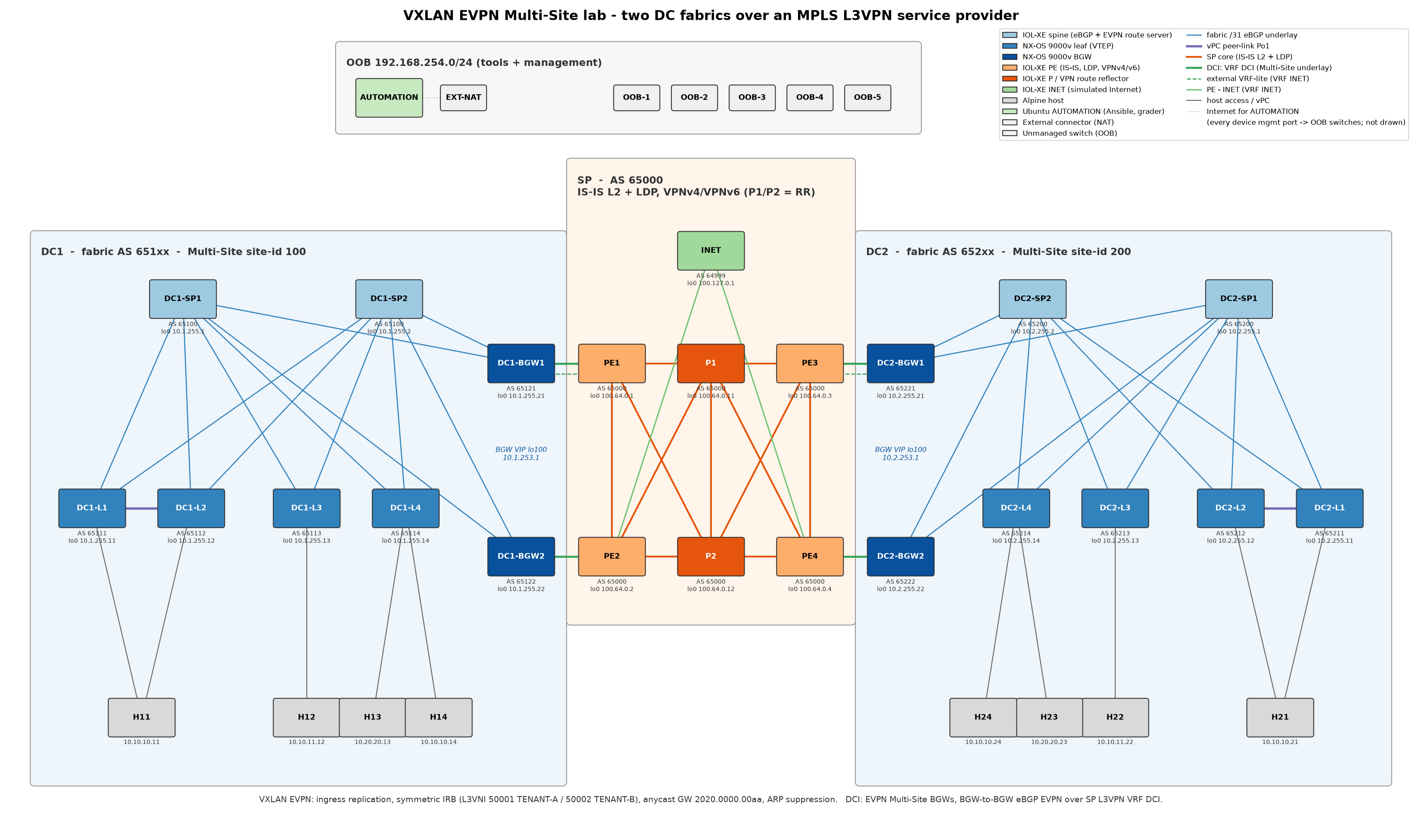
What the drawing is showing
DC1 is fabric AS 651xx: spines DCI-SP1 and DCI-SP2, leaves DCI-L1 through DCI-L4, border gateways DCI-BGW1 and DCI-BGW2, and hosts H11 through H14. DC2 mirrors it as fabric AS 652xx, site-id 200, with DC2-SP1, DC2-SP2, DC2-L1 through DC2-L4, DC2-BGW1, DC2-BGW2, and hosts H21 through H24. The provider is AS 65000, IS-IS level 2 plus LDP, with VPNv4 and VPNv6. P1 and P2 are the route reflectors; PE1 through PE4 face the border gateways, and INET sits above the core. Border-gateway to border-gateway EVPN runs over that L3VPN. The fabrics use ingress replication, symmetric IRB, L3VNIs 50001 (TENANT-A) and 50002 (TENANT-B), anycast gateway MAC 2020.0000.00aa, and ARP suppression. An out-of-band network on 192.168.254.0/24 carries management, an automation host, and external NAT. Built in Cisco Modeling Labs. No answer key is published.
Covered here
- VXLAN EVPN
- Multi-site BGWs
- IS-IS and LDP
- VPNv4/VPNv6
- Symmetric IRB
All labs · CCIE EI dual-stack enterprise · OSPF and EIGRP redistribution